
ActionType catalog, and every ATP REST endpoint, see Artemis Transmission Protocol (ATP) in the API reference. Use this page to go from “I have data to send” to a validated, routable message.
ATP in the architecture
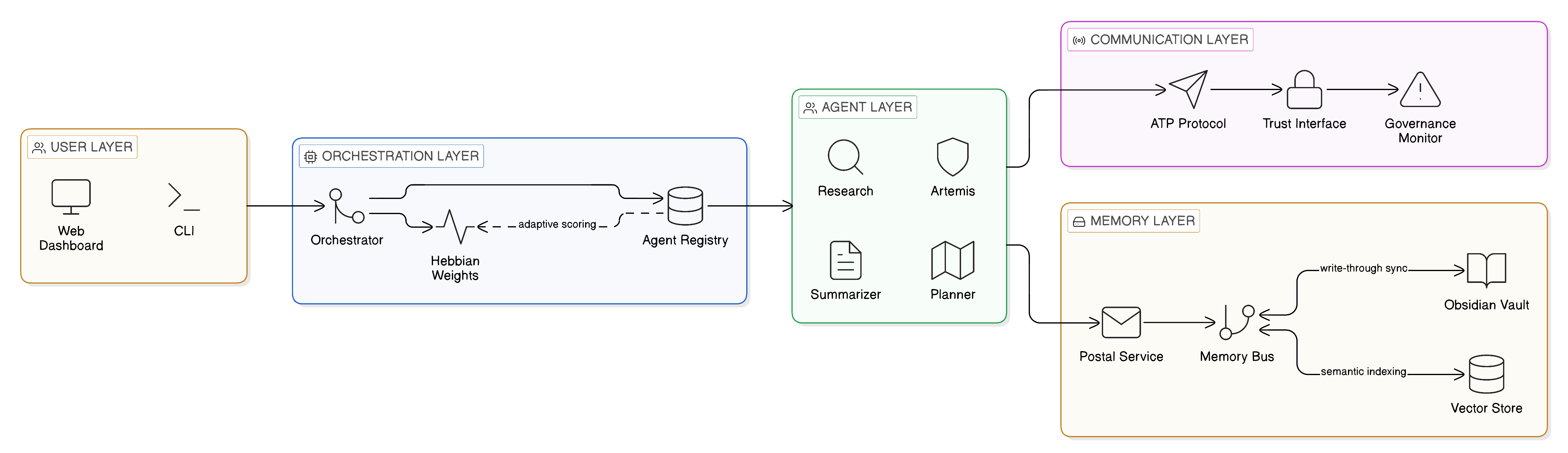
api/openapi.yaml.
- Builder
- Example exchange
- Playground
Every ATP message is six header tags followed by a JSON body. Fill them in this order:Assembled, a memory lookup looks like this:Before sending, run it through
1
Mode
How the message should be delivered:
direct, batch, stream, or async. Most agent-to-agent calls are direct.2
Context
A trace/correlation ID, unique per logical operation (max 64 chars). Reuse the same
Context across a request/response pair so the two sides of an exchange can be joined in logs and in GET /api/v1/atp/queue.3
Priority
critical (0), high (1), normal (2), or low (3) — determines queue order, not correctness. Reserve critical for governance overrides and rollbacks.4
ActionType
What the receiving agent should do with the payload —
query, execute, propose_update, and so on. See the full catalog grouped by Query / Modification / Execution / Management / Governance operations in the ATP reference.5
TargetZone
Which system component owns this:
kernel, registry, memory, sandbox, or governance. This is what the router matches on.6
SpecialNotes (optional)
Free-text hints for the receiving agent, max 256 chars — for example
retry on timeout or require_semantic_match=true.POST /api/v1/atp/validate — it checks structural and field-level errors without dispatching anything, so it’s safe to call from client-side forms or CI. POST /api/v1/atp/format returns the exact wire string for a payload if you want to confirm formatting before it ships.Related
- Artemis Transmission Protocol reference — full tag spec,
ActionTypecatalog, and every ATP REST endpoint - Trust scoring and access levels — how
senderIdtrust affects whichActionTypevalues an agent is actually allowed to issue - Multi-agent communication — how
TargetZoneand routing modes interact